


When it comes to diesel engine performance, most people focus on major components: turbochargers, pistons, cylinder heads.
But one of the most overlooked factors in engine performance, efficiency, and longevity is fuel injector balance.
Specifically, how closely each injector matches the others in fuel delivery.
That’s where flow-matched fuel injectors come in.
What Are Flow-Matched Diesel Fuel Injectors?
Quick takeaway: Flow-matched injectors are tested and grouped to deliver nearly identical fuel volume across all cylinders.
Flow-matched injectors are sets that have been:
- Tested on a calibrated flow bench
- Measured under simulated operating conditions
- Grouped to ensure minimal variance between injectors
Typical variance:
- Standard injectors: ±5–10% flow variation
- Flow-matched sets: within ±1–2%
That difference directly impacts how evenly your engine runs.

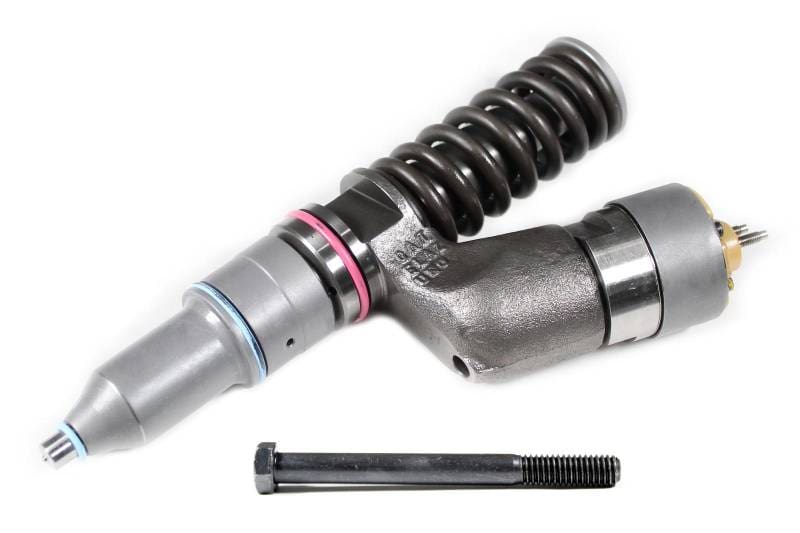
Caterpillar C15 Acert, C15 Flow-Matched Fuel Injector
Caterpillar C15, 3406E Flow-Matched Fuel Injector
Why Injector Balance Matters More in Diesel Engines
Quick takeaway: Diesel engines rely on precise fuel delivery per cylinder—there’s no margin for imbalance.
Unlike gasoline engines, diesel engines:
- Do not use spark ignition
- Depend entirely on fuel injection timing and pressure
- Operate at extremely high compression ratios
Because of this, small differences in fuel delivery create major differences in combustion.
Even slight injector imbalance can cause:
- Uneven cylinder temperatures
- Inconsistent combustion timing
- Increased mechanical stress
What Happens When Injectors Are NOT Flow Matched
Quick takeaway: Uneven fueling creates a chain reaction of performance and durability issues.
If injectors vary significantly in flow rate, you can see:
Cylinder Imbalance
- One cylinder runs rich, another runs lean
- Leads to uneven power contribution
Temperature Variations
- Over-fueling → higher EGTs (exhaust gas temperatures)
- Under-fueling → incomplete combustion
Long-Term Damage Risks
- Piston crown damage
- Cylinder scoring
- Valve and seat wear
👉 This is especially critical in engines like:
- Caterpillar C15 / 3406E
- Cummins ISX / X15 / N14
The Flow-Matching Process (What Actually Happens)
Quick takeaway: Matching injectors is a controlled testing and sorting process—not just “checking them.”
1. Cleaning and Preparation
- Ultrasonic cleaning removes carbon and deposits
- Reverse flushing clears internal passages
2. Flow Bench Testing
Injectors are tested under:
- Static flow (constant open)
- Dynamic/pulsed flow (simulated engine operation)
Measurements include:
- Fuel volume delivery
- Spray pattern consistency
- Response timing
3. Sorting and Matching
Injectors are grouped based on:
- Flow rate similarity
- Spray pattern uniformity
Only injectors within tight tolerances are paired into a set.
4. Validation and Reporting
High-quality sets include:
- Flow data reports
- Cylinder-to-cylinder variance documentation
HEUI vs Common Rail: Why Matching Still Matters
Quick takeaway: Even advanced systems cannot fully compensate for injector imbalance.
HEUI Systems (Caterpillar 3406E, C15)
- Injection driven by oil pressure
- Highly sensitive to injector performance variation
Common Rail Systems (Cummins ISX, X15)
- ECM can adjust fueling slightly per cylinder
- But cannot fully correct mechanical injector differences
👉 Bottom line:
Even with ECM compensation, mechanical balance still matters
When Flow-Matched Injectors Are Most Important
Quick takeaway: The more demanding the application, the more critical injector matching becomes.
Flow-matched injectors are strongly recommended for:
- High horsepower builds
- Engines running increased boost
- Engines under heavy or constant load
- Performance-tuned applications
When They May Not Be Necessary
For:
- Stock engines
- Light-duty applications
- Mild tuning setups
Standard injectors may be acceptable—if they are high quality and properly calibrated
Cost vs Performance: Is It Worth It?
Quick takeaway: Flow matching is about consistency—not just peak power.
Flow-matched injectors:
- Reduce tuning variability
- Improve idle quality
- Increase long-term reliability
They are not just about performance—they are about engine balance
The Bigger Issue: Calibration Still Matters
Even perfectly matched injectors require:
- Proper installation
- Correct torque procedures
- ECM calibration (where applicable)
Without calibration:
👉 You can still have performance issues—even with matched injectors
What This Means for Your Engine
At the end of the day, diesel engines are systems.
Fuel delivery, air flow, compression, and timing all work together.
Flow-matched injectors help ensure:
- Every cylinder contributes equally
- Combustion stays consistent
- The engine runs smoother and lasts longer
HHP Insight: Where Flow Matching Really Pays Off
Most injector failures and performance issues we see aren’t caused by a single bad component.
They’re caused by imbalance across the system.
That’s why choosing the right injectors matters.
👉 Shop All Our Diesel Fuel Injectors
👉 Browse Caterpillar Fuel injectors
👉 Browse Cummins Fuel Injectors
If you’re building an engine, diagnosing performance issues, or trying to prevent repeat failures, injector consistency should be part of the conversation.
Final Thoughts
Flow-matched fuel injectors are not always required – but in the right applications, they make a measurable difference.
They reduce variability, improve combustion consistency, and help protect your engine over time.
And in diesel engines, where precision matters more than anything – that balance is critical.
Call 844-304-7688 or visit highwayandheavyparts.com to place your order today.
From diagnosis through delivery, we’re Highway and Heavy Parts.


