


Your truck is often put through grueling conditions and is expected to perform while giving nothing less than 100%. But just like anything else, diesel engines will have components that will fail if not properly maintained. Common parts like filters, gaskets, and even injectors will eventually need to be swapped out. It is just a matter of time.

With proper maintenance, certain key components such as oil coolers, pumps, and even camshafts could easily go past the 1,000,000 mile mark. If you think it may be time for a new camshaft, it is best to check with a reputable supplier before pulling the trigger. We carry a wide array of replacement parts for your diesel engine. Have a look at the various camshafts and drivetrain components we offer here.
How Have Camshafts Changed Over The Years?
Even 20 years ago, a diesel engine was nowhere near as complicated as it is today. New twin-turbo, emissions-ridden engines have become more powerful and even more complicated. In our ever-evolving desire for both increased fuel economy and horsepower, components such as camshafts have become a commonplace replacement part.
For example, NASCAR uses more aggressive camshaft lobes to squeeze out every last horsepower from an engine. The same technology applies to modern diesel engines. However, by doing this, additional stress is put on certain drivetrain components.
Not sure if your diesel engine’s camshaft needs to be replaced? We’ve put together an in-depth camshaft failure article here. It will give you all the necessary information about camshaft wear, what causes it, and most importantly, what can be done to prevent it.
How Do Newer-Style Camshafts Affect Your Engine Rebuild?
As previously mentioned, newer diesel engines take advantage of the latest technology. Sadly, that is often at the cost of reliability. New camshafts are so advanced in design that most mechanics are not able to accurately measure the wear. Oftentimes they are sent out to a specialized shop if even the slightest sign of visual damage is present. If camshaft followers are present in your engine, chances are that they will need to be replaced as well.
The reason why a camshaft gets sent out to a specialist is that it requires a whole host of specialized machinery and equipment to properly determine if it can be resurfaced or reused. Do you have over 100K dollars to spend on a measuring stand or even 1,000,000 dollars on specific CNC machines? It is one of the main reasons that specialized businesses exist.
Here is a diagram that we’ve put together to show you exactly why identifying a modern worn-out camshaft can be so difficult in today’s diesel engines. It may be simple, but it works wonderfully when trying to explain how new camshafts differ from old ones.
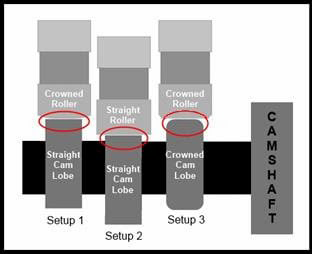
*Keep in mind that each setup shown is unique to each engine. While camshaft lobes look worn on one model, they can be perfectly functional on another.
Setup 1
The diagram shows a flat camshaft lobe and a tapered roller follower for that specific setup. Under ideal operating conditions, the contact point is centered in the lobe.
This allows wear to be put on the center of the cam and not on the sides, where it is significantly weaker. In older systems, this camshaft lobe profile is most commonly used, allowing for simple diagnosis and repair.
Setup 2
Although similar to setup 1, the second setup utilizes a camshaft lobe and a roller follower. What does this mean? It means that you get an increased contact surface area. Yes, an increased contact area is a benefit of using this setup, but it also has its downsides.
The area circled in red shows where unnecessary pressure can be placed on the edges of the cam’s lobe. Generally, this is the weakest part, and putting excessive pressure on the ends could increase the chance of damage.
Setup 3
The 3rd setup shows the use of a camshaft lobe with a crown roller follower. Although the crown is very visible in the diagram, it can be nearly impossible to spot with the naked eye. This is where the specialized machinery mentioned earlier would come in handy.
Most new diesel engines are adopting this design as it increases their overall strength by keeping pressure away from the weak lobe and follower sides. However, the downside is that the naked eye cannot tell if the camshaft is overly worn out. This result is that mechanics unknowingly reinstall a potentially defective part, allowing for future problems down the road.
Even specialized shops may unknowingly grind back the specific profile of modern camshafts found on new diesel engines. Rebuilding camshafts by grinding and resurfacing them may have worked in the past. But modern camshaft designs have only left one solution, and that is a camshaft replacement.
Of course, anything can be done with enough time, money, and most importantly, patience. Putting a lobe back on a resurfaced rebuilt camshaft is possible, but it will never be as durable as the ones that came from the factory. Reduced power, increased fuel consumption, and general wear and tear are common with rebuilt camshafts.
Want to learn more about the reconditioning process and how camshafts can be rebuilt? We have a detailed post about camshafts here!
Is Changing My Camshaft Necessary?
Much like any other major repair on your truck, replacing your camshaft is a big job and a lot of careful thought must go into it before you make a final decision. How much longer are you planning to use the truck before “retiring” it? How much does a camshaft rebuild cost vs buying a new one? All of these questions should be considered before opting out for a brand-new one.
Regardless of what your plan for your truck is, any visible damage to the camshaft should be cause for concern. Not only can it reduce horsepower, but it can cause other serious issues to your engine. Keeping your diesel engine running right will end up paying for itself in the long run as any time not spent behind the wheel means lost income.
Final Words
Do you think that a damaged camshaft may be the cause of your engine troubles? Highway & Heavy Parts has several camshafts in stock and ready to go for your diesel engine. We’ve even created a guide outlining some of the most important tips when installing a new camshaft.
Our ASE-certified staff is ready to answer any questions you might have about camshafts or any other related problems. Call us at 1-844-985-3408 or request a quote online today!
Relates Videos:


Short on Time? Take your Quote Online!
We get it- when you need Diesel Engine Parts, time is of the essence. That’s why we’ve developed the HHP Online Quoting System.


