The huge company that is Cummins was founded almost a century ago in 1919 by Clessie Cummins. Cummins partnered with J. Irwin Miller, who helped Mr. Cummins grow his business. With Cummins’ diesel knowledge and Miller’s business expertise, the company quickly grew. In the years after World War II, the N-Series heavy duty trucks helped the company become an industry leader, and the company’s first overseas facility was built in Scotland in 1956.
Continue reading Cummins ISX Engine SpotlightCategory: Cummins Diesel Engine Parts & Components
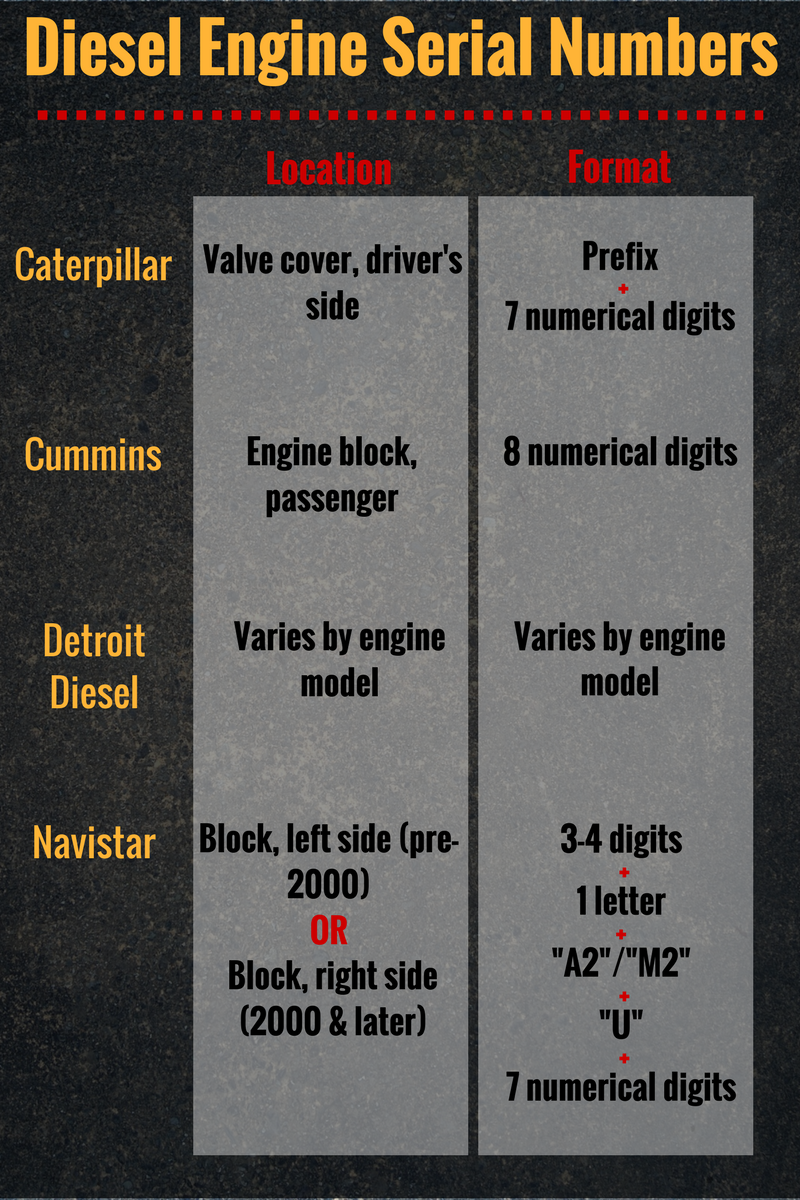
Diesel Engine Serial Numbers
Have you ever thought much about your ESN or why you might need to know it? Diesel engine serial numbers are vital to ensuring you’re getting the right fit for your engine.
Continue reading Diesel Engine Serial NumbersReusing Pistons to Save Money: The Benefits and Drawbacks
Rebuilding an engine on a Class 8 truck is a costly procedure. Depending on how extensive the repairs are, the parts alone can range from fifteen hundred to fifteen thousand dollars. One option for reducing the cost of an engine overhaul rebuild is to reuse the pistons. The pistons are typically the single most expensive part in a rebuild kit. Taking them out can make the kit affordable for nearly everyone’s budget.
Continue reading Reusing Pistons to Save Money: The Benefits and DrawbacksHow to Get Better Fuel Economy with your Diesel Truck
Diesels are known to get great mileage. They typically deliver 25 to 30 percent better fuel economy than similarly performing gasoline engines. Although diesel fuel used to be cheaper than gasoline, it now tends to cost the same or more.
Continue reading How to Get Better Fuel Economy with your Diesel TruckN14 Piston Skirt Design Change
Cummins made a change to their Diesel N14 piston skirt design. Although this change was made some time ago, it is still causing some confusion.
Continue reading N14 Piston Skirt Design ChangeCummins Wins Frost & Sullivan 2014 US Overall Best Heavy-duty Truck Engines Award
According to Frost & Sullivans independent research surveying heavy-duty fleet, safety, maintenance and service managers across the US, Cummins Inc. was named the overall best heavy-duty truck engine supplier. Cummins reeled in 49 percent of the votes with its closest competitor capturing only 23 percent.
Continue reading Cummins Wins Frost & Sullivan 2014 US Overall Best Heavy-duty Truck Engines AwardCummins N14 Inframe Rebuild Kit – Additional Items
We’re discussing some inexpensive additional pieces you should think about changing when you rebuild your Cummins N14. The Cummins N14 is a strong, reliable engine that will just keep on going if you treat it right. Depending on how much weight you’re pulling, the average rebuild is needed around 800k to 1 million miles. The standard N14 inframe kit will come with nearly everything you need to rebuild the engine. Here’s a look at some of the additional pieces that are a good idea to change while performing the rebuild. The nice thing is, they won’t break the bank.
Continue reading Cummins N14 Inframe Rebuild Kit – Additional ItemsHighway & Heavy Parts Adds New Parts To Inventory For Increased Coverage
Highway and Heavy Parts (HHP) is pleased to announce the addition of a wide range of new products to their existing line of diesel engine components. These new products include an array of cost-saving components for Caterpillar’s 3406E, C11, C15 and C13 engine applications as well as oversize repair options for Cummins Midrange Engines and fuel system parts for Detroit Diesel Series 60 engines. The addition of these new products to HHP’s already extensive catalogue of parts has helped them expand their coverage of diesel engine applications and better serve the needs of the heavy highway industry.
Continue reading Highway & Heavy Parts Adds New Parts To Inventory For Increased CoverageIncrease Profit with Remanufactured Injectors From HHP!
When it comes to running a highly profitable diesel engine repair shop, staying one step ahead of your competition is critical to success. With profit margins shrinking and customer demands becoming more and more complex, vendors are constantly searching for ways to cut costs and streamline operations, all without having to sacrifice the quality of their service. Though this has proved to be a difficult task for a lot of repair shops, many are discovering that making the switch from OEM parts to remanufactured components may be the answer, and Highway and Heavy Parts (HHP) is helping them do that.
Continue reading Increase Profit with Remanufactured Injectors From HHP!HHP is pleased to announce the addition of a wide range of new diesel engine products to their existing line of parts
Highway and Heavy Parts is pleased to announce the addition of a wide range of new diesel engine products to their existing line of parts.
Continue reading HHP is pleased to announce the addition of a wide range of new diesel engine products to their existing line of partsWhy Diesel Engines Sound Different Than Gas Engines
Diesel and gasoline engines both rely on combustion to produce power, but the way that combustion occurs is fundamentally different.
Those differences directly affect:
- Pressure rise inside the cylinder
- Combustion timing
- Vibration and structure-borne noise
👉 The result is the distinct sound commonly associated with diesel engines.
Combustion Method: Spark Ignition vs Compression Ignition
The primary difference begins with how the fuel ignites.
Gasoline engines use spark ignition:
- Air and fuel are mixed before entering the cylinder
- A spark plug ignites a relatively uniform (homogeneous) mixture
- Combustion begins at a controlled point and spreads smoothly across the chamber
Diesel engines use compression ignition:
- Only air is compressed during the compression stroke
- Fuel is injected directly into hot, highly compressed air
- No spark plug is used
👉 This creates a non-uniform (heterogeneous) air-fuel mixture, where combustion begins in multiple localized regions.
Rapid Pressure Rise and Diesel “Knock”
One of the main contributors to diesel sound is how quickly pressure rises during combustion.
In a diesel engine:
- Fuel is injected into very hot, high-pressure air
- There is a short delay before ignition (ignition delay)
- During this delay, fuel continues to accumulate in the cylinder
When ignition begins:
- Multiple pockets of fuel-air mixture ignite nearly simultaneously
- This results in a rapid pressure rise inside the cylinder
👉 That rapid pressure rise produces the sharp “knock” or “clatter” associated with diesel engines.
This is often referred to as diesel knock, and it is different from uncontrolled knock in gasoline engines.
Diesel Knock vs Gasoline Engine Knock
It is important to separate these two concepts.
In gasoline engines:
- Knock (detonation) is abnormal combustion
- It occurs when the air-fuel mixture ignites prematurely
- It can cause engine damage
In diesel engines:
- Combustion always occurs through compression ignition
- The rapid ignition of accumulated fuel is part of normal operation
- The resulting pressure waves create noise
👉 Diesel knock is a controlled phenomenon, not a failure condition.
Fuel Injection Pressure and Atomization
Another major factor in diesel engine sound is the fuel injection system.
Diesel engines use:
- Extremely high injection pressures (often 20,000–40,000+ PSI in modern systems)
- Precision injector nozzles to atomize fuel
High-pressure injection creates:
- Very fine fuel droplets
- Rapid mixing with compressed air
- Localized combustion zones
👉 The injection event itself contributes to noise, both mechanically and through combustion dynamics.
Older mechanical injection systems were especially noisy due to:
- Mechanical actuation
- Abrupt fuel delivery
- Less precise control of injection timing
Multiple Injection Events in Modern Diesel Engines
Modern diesel engines have significantly reduced noise compared to older designs.
This is largely due to common rail injection systems, which allow:
- Pilot injection (small amount of fuel injected before the main event)
- Main injection
- Post injection (in some cases)
Pilot injection is especially important because it:
- Begins combustion earlier with a smaller fuel quantity
- Reduces the amount of fuel accumulated before ignition
- Lowers the rate of pressure rise
👉 This results in smoother combustion and reduced noise.
Structural Transmission of Noise
The sound you hear is not just combustion – it is how that combustion is transmitted.
Diesel engines typically have:
- Higher compression ratios
- Heavier internal components
- Stronger engine structures
The rapid pressure rise during combustion creates:
- Vibrations in the cylinder walls
- Forces transmitted through the crankshaft and block
- Structure-borne noise that travels through mounts and drivetrain
👉 These vibrations are radiated as the characteristic diesel “clatter.”
Operating Conditions and Load
Diesel engine sound also changes based on operating conditions.
At higher loads:
- More fuel is injected
- Combustion pressure increases
- Noise becomes more pronounced
At lighter loads or idle:
- Less fuel is injected
- Combustion events are smaller
- Noise may be sharper but less intense
This is why diesel engines often sound different:
- At idle
- Under acceleration
- Under heavy load
Summary of Key Differences
Diesel engines sound different than gasoline engines due to:
- Compression ignition instead of spark ignition
- Heterogeneous air-fuel mixture
- Rapid pressure rise during combustion
- High-pressure fuel injection systems
- Structural transmission of vibration
Modern diesel engines reduce this noise through:
- Advanced injection timing control
- Multiple injection events
- Improved engine design and insulation
Final Takeaway
The characteristic sound of a diesel engine is a direct result of how combustion occurs.
It is not simply “louder” or “rougher” – it reflects:
- High compression
- Controlled rapid ignition
- High-pressure fuel delivery
👉 Diesel engine noise is a byproduct of an efficient, high-load combustion process designed for durability and torque.
Call 844-304-7688 or visit highwayandheavyparts.com to get the right diesel engine parts for your application.
From diagnosis through delivery, we’re Highway and Heavy Parts.
New 4059429 connecting rods for Cummins ISX engines
Connecting rod 4059429 replaces connecting rod 4923749. This is a drilled connecting rod. Cummins engine company has made a change in their connecting rod design. Many of the ISX engines were built with “non-drilled” connecting rods. These non-drilled Cummins ISX connecting rods have been replaced by drilled connecting rods. For further clarification on connecting rod changes on ISX engines look at Cummins Reference TSB100666. Newer ISX engines (starting with ESN 79614966) were built with fractured rods. Saw cut and fractured rods can be mixed in an engine per Cummins Engine Company TSB120067.
Continue reading New 4059429 connecting rods for Cummins ISX enginesYour Premier Source for Cummins Heavy-Duty Engine Parts
Highway and Heavy Parts is the premier source for high-quality heavy-duty Cummins diesel engine parts. You know the value of dependable and long-lasting parts as a fleet owner, technician, or equipment operator to maintain your Cummins engines operating at their peak efficiency.
Here you will find blogs that focus on Cummins diesel engines and the heavy-duty parts you need to keep your large truck on the road. Read about diesel engine issues, diagnostic tips, and the best engine parts for the job.
Complete Cummins Engine Coverage
Popular Cummins Engine Models
Our comprehensive inventory covers all major Cummins engine families, including ISX, ISX15, N14, ISM, ISC, M11, and X15 engines. Whether you’re maintaining legacy engines or modern powerplants, we stock the critical components needed to keep your Cummins engines performing at their best.
ISX and N14 Engine Solutions
The ISX12 and ISX15 were involved in the phase out of the N14 and M11 engines, which were unable to meet emissions standards. Because of the shift to electronic controls, the N14 has more valve train components than the ISX. We carry parts for both engine families to support your fleet’s diverse needs.
Quality Cummins Components & Services
Engine Rebuild Parts
From complete engine rebuild kits to individual components, our Cummins parts selection includes pistons, cylinder heads, fuel injectors, turbochargers, and gasket sets. Whether you’re performing routine maintenance or major rebuilds, we have the quality parts you need.
Engine Identification Support
Need help identifying your Cummins engine? For ISB engines, you’ll find the serial number on your rocker cover or on the side of the gear housing. For Cummins ISM engines, the serial number is located on the rocker housing on the fuel pump side. Our experts can help you identify the right parts for your specific engine model.
Why Choose Highway and Heavy Parts for Cummins?
Unmatched Expertise
Our diesel engine experts understand the evolution of Cummins engines and can help you navigate the differences between engine families. From the mechanical N14 to the electronic ISX series, we know what it takes to keep these engines running strong.
Quality & Reliability
Every Cummins component in our inventory meets or exceeds OEM specifications. We understand that downtime is costly, which is why we stock only the highest quality parts designed for durability and long-lasting performance.
Comprehensive Support
Whether you’re rebuilding a Cummins ISX or maintaining an N14, our team provides expert technical support and fast shipping to minimize your equipment downtime. We serve fleet owners, technicians, and equipment operators with the parts and knowledge they need.
Fast Service & Shipping
With our extensive inventory and efficient logistics, we can quickly get you the Cummins parts you need. Our commitment to fast service helps keep your heavy-duty equipment operational and productive.
Browse Our Complete Cummins Parts Catalog
Browse our complete Cummins parts catalog today and discover why Highway and Heavy Parts is the trusted choice for diesel professionals nationwide.


