


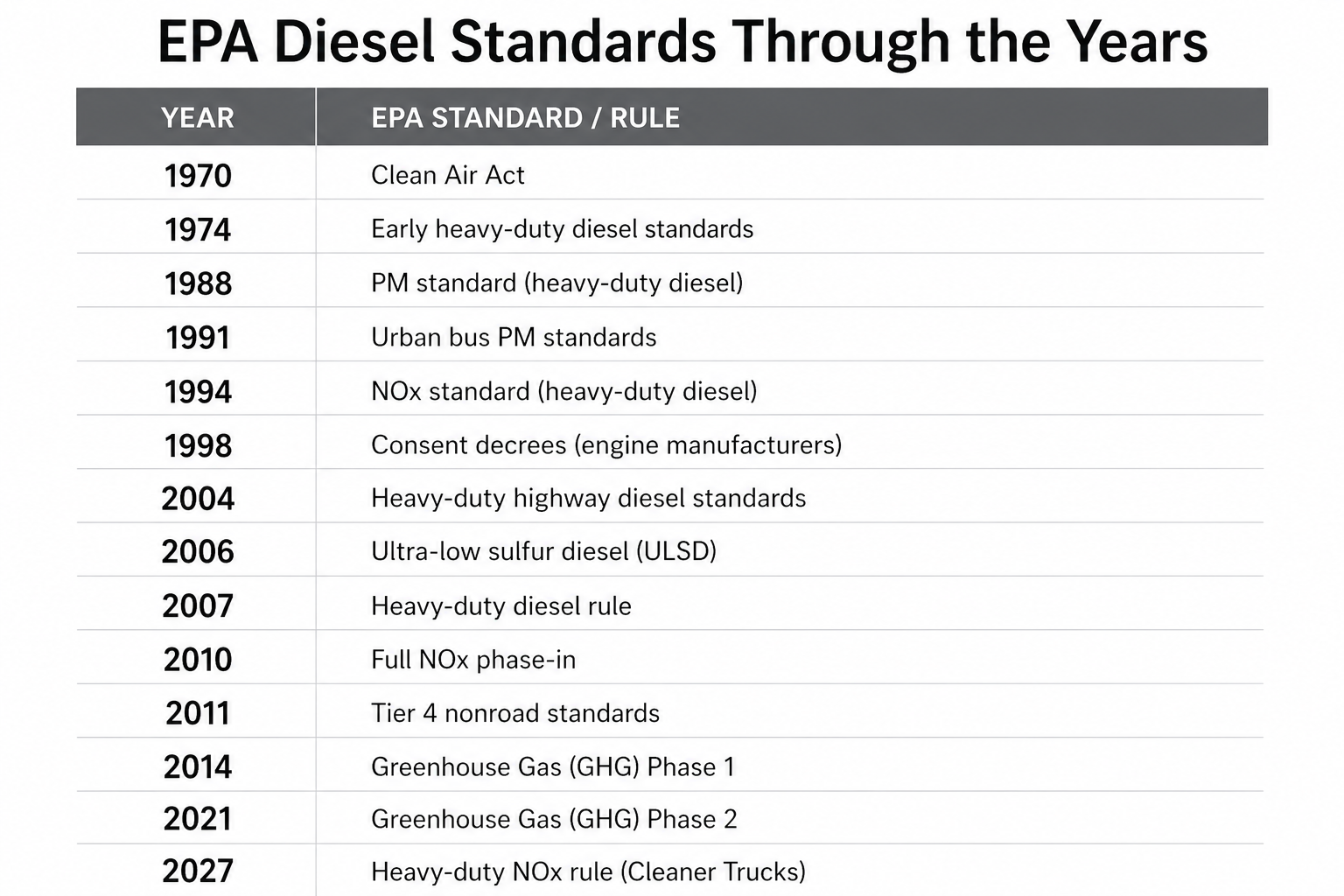
Vehicle emissions regulations did not happen all at once.
They developed over decades as engineers, regulators, and manufacturers responded to air quality problems caused by hydrocarbons, carbon monoxide, nitrogen oxides, particulate matter, and later greenhouse gas emissions.
For diesel engines, the biggest changes came when regulations began focusing more heavily on particulate matter, NOx, fuel sulfur levels, and aftertreatment systems.
1960s: California Leads Early Emissions Regulation
Modern vehicle emissions regulation began largely because of severe smog problems, especially in California.
In 1966, California adopted the nation’s first tailpipe emissions standards for hydrocarbons and carbon monoxide. Later, California also adopted standards for oxides of nitrogen and diesel particulate matter.
This mattered because California became a testing ground for stricter emissions control technology.
1970: Clean Air Act and the EPA
The Clean Air Act of 1970 created a much stronger federal role in regulating air pollution.
That same year, the U.S. Environmental Protection Agency began operating as the federal agency responsible for enforcing environmental regulations.
For vehicles, the Clean Air Act pushed manufacturers toward major reductions in tailpipe pollutants such as:
- Hydrocarbons
- Carbon monoxide
- Nitrogen oxides
As a result, emissions control became part of vehicle design rather than an afterthought.
1970s: Catalytic Converters and Cleaner Gasoline Vehicles
During the 1970s, emissions standards helped drive the widespread use of catalytic converters on gasoline-powered vehicles.
Catalytic converters reduce pollutants in exhaust by converting harmful gases into less harmful compounds.
This era was mostly focused on passenger vehicles, but it set the foundation for the idea that emissions rules and engine technology would continue evolving together.
1980s: Diesel Particulate Matter Becomes a Bigger Focus
As regulators gained a better understanding of diesel exhaust, particulate matter became a major concern.
California adopted particulate matter standards for diesel-fueled vehicles in 1982.
By the late 1980s, diesel emissions control was becoming more specific and more technical. Instead of only focusing on visible smoke, regulations increasingly targeted measurable pollutants like PM and NOx.
1990s: Clean Air Act Amendments and Broader Controls
The 1990 Clean Air Act Amendments expanded emissions regulation and strengthened national air quality programs.
This era helped push cleaner fuels, improved engine controls, and broader emissions requirements across more vehicle and engine categories.
For diesel engines, this period was important because it helped move the industry toward more advanced combustion control, electronic engine management, and future aftertreatment systems.
Early 2000s: Tier 2 and Fuel Quality Become Linked
The Tier 2 Vehicle and Gasoline Sulfur Program began in the early 2000s and treated vehicles and fuel as a connected system.
EPA describes Tier 2 as a program that affected every new passenger vehicle and every gallon of gasoline sold in the United States. It also required cleaner vehicles and lower-sulfur fuel to work together.
This idea became important for later diesel regulations too.
Cleaner fuel allows emissions control devices to work properly. Without fuel sulfur reductions, many modern aftertreatment technologies would not survive or perform correctly.
2006–2010: Ultra-Low Sulfur Diesel and Modern Heavy-Duty Diesel Standards
One of the biggest turning points for diesel engines was the move to ultra-low sulfur diesel.
EPA notes that sulfur can damage emissions control devices, which is why diesel fuel sulfur levels were reduced by more than 99 percent. Ultra-low sulfur diesel has a maximum sulfur concentration of 15 parts per million.
This fuel change helped make modern diesel aftertreatment possible.
During the 2007–2010 period, heavy-duty highway diesel engines faced much stricter emissions standards.
The 2007 heavy-duty program introduced very low particulate matter limits, while NOx reductions phased in through 2010. DieselNet summarizes the standards as 0.01 g/bhp-hr for PM and 0.20 g/bhp-hr for NOx, with PM taking full effect in 2007 and NOx phasing in between 2007 and 2010.
These standards helped drive widespread adoption of:
- Diesel particulate filters
- Exhaust gas recirculation
- Selective catalytic reduction
- Diesel oxidation catalysts
- DEF systems
For heavy-duty diesel engines, this was one of the most significant technology shifts in modern history.
2014–2017: Tier 3 and Integrated Vehicle/Fuel Standards
EPA finalized Tier 3 standards in 2014.
Tier 3 continued the approach of treating the vehicle and fuel as an integrated system. EPA states that Tier 3 reduced both tailpipe and evaporative emissions and lowered gasoline sulfur to support more effective emissions control systems.
EPA’s gasoline sulfur information also notes that Tier 3 lowered gasoline sulfur to a maximum of 10 ppm beginning in 2017.
Although Tier 3 primarily focused on gasoline vehicles and light-duty applications, it reflects the broader direction of emissions regulation: cleaner fuel, cleaner engines, and more durable emissions systems.
Modern Diesel Emissions Systems
Today’s diesel engines rely on multiple systems to meet emissions requirements.
Common technologies include:
- EGR to reduce combustion temperature and NOx formation
- DPF systems to capture particulate matter
- SCR systems to reduce NOx downstream
- DEF dosing to support SCR operation
- Sensors and ECM controls to monitor system performance
These systems are not separate from engine performance.
They affect:
- Fuel strategy
- Exhaust temperature
- Regeneration events
- Engine derate logic
- Maintenance requirements
As a result, modern diesel diagnostics require understanding both engine operation and aftertreatment behavior.
International Development
Vehicle emissions regulation also developed globally.
Europe introduced vehicle emissions limits in the 1970s and later built its own staged standards through the Euro emissions system.
Over time, regulations in the United States, Europe, and other markets have increasingly focused on the same major pollutant groups:
- NOx
- PM
- Hydrocarbons
- Carbon monoxide
- Greenhouse gases
The exact standards differ by region, but the overall direction has been consistent: lower emissions through cleaner fuel, improved engine control, and more advanced exhaust aftertreatment.
Why Emissions Regulations Changed Diesel Engines
Emissions regulations reshaped diesel engine design.
Older diesel engines relied more heavily on mechanical fuel systems and simpler exhaust layouts.
Modern diesel engines use:
- Electronic fuel injection
- High-pressure common rail systems
- Turbocharger control
- Exhaust gas recirculation
- Aftertreatment sensors
- DPF and SCR systems
Because of this, modern diesel engines are cleaner, but they are also more complex.
That complexity makes accurate diagnosis more important than ever.
If you want a deeper look at how modern EPA standards changed diesel engine design, fuel systems, aftertreatment components, and long-term maintenance requirements, read our guide on How EPA Emissions Regulations Have Affected Diesel Engines.
Final Takeaway
The history of emissions regulations is really the history of how engines, fuels, and exhaust systems changed together.
From California’s early tailpipe standards in the 1960s to federal Clean Air Act programs, ultra-low sulfur diesel, DPF systems, SCR, and DEF, each stage pushed engine technology forward.
For diesel engines, the biggest changes came when regulations targeted particulate matter and NOx while also requiring cleaner fuel.
That combination created the modern diesel emissions systems used today.
Call 844-304-7688 or visit highwayandheavyparts.com to get the right diesel engine parts for your application.
From diagnosis through delivery, we’re Highway and Heavy Parts.


