Finding the correct engine serial number (ESN) is one of the most important steps when ordering diesel engine parts – but it’s also one of the most confusing. Every manufacturer places their serial numbers in different locations, and many engines have additional arrangement, horsepower, or build codes that matter just as much as the ESN itself.
In this guide, we break down exactly where to find the serial number on popular diesel engines like Caterpillar, Cummins, and Detroit Diesel, so you can identify your engine quickly and get the right parts the first time.
Download this Free ESN Lookup Guide!
How To Find Your Diesel Engine Serial Number
Sometimes it can be hard to find an ESN. Below we’ve collected the general formats your ESNs will have and where you can find them on your engine.
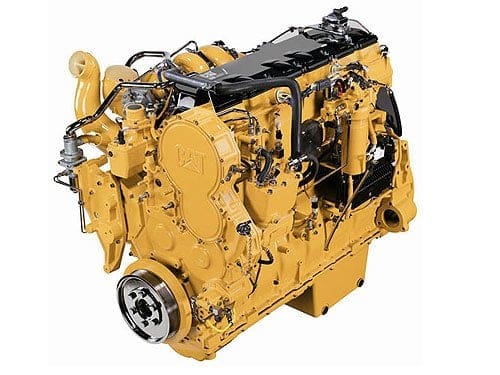
Caterpillar Engine Serial Number Location
Most engine serial numbers can be found on the data-plate. As you’ll see later in this article, the data-plates for a certain type of engine can be found in various places depending on the model. However, Caterpillar is pretty consistent, and the data-plate on a Caterpillar engine can be found on the driver’s side of the valve cover.
Caterpillar Engine Serial Number Identification
All Caterpillar ESNs have a similar format. They all begin with a three number/letter prefix, followed by 7 digits. The prefixes will correspond to a particular model. For example, prefixes of 1LW, 2WS, 5DS, 5EK, and 6TS indicate that the engine is a 3406E. For the more popular prefixes, people will refer to their engine by the prefix rather than the model.
You may have heard someone say, “Oh, yeah, my 6NZ runs like a champ.” A 6NZ is a common prefix for a single-turbo C15. Some prefixes’ reputations precede them. For example, a C15 with a prefix of MBN is known as a “Bridge motor” (because it was the bridge engine from the mechanical C15 to the electronic C15 ACERT), and is often heavily critiqued.
Caterpillar ESN Prefixes by Model
3406:
3406B:
- 2EK
- 3ZJ
- 4CK
- 4MG
- 5KJ
- 7FB
- 8TC
3406C:
3406E:
C7:
C12:
- 1YN
- 2KS
- 8YF
- 9NS
- 9SM
- CPD
- GEP
- MBL
- TME
C15 and C15 ACERT:
- 6NZ
- 9NZ
- B5R
- BXS
- EGH
- JEP
- KRA
- MBN
- MXS
- NXS
- RKS
- SDP
- TRB
C16:
Cummins Engine Serial Number Location
Cummins engine will have the engine serial number on the dataplate; however, the dataplate will be in different locations based on the model of the engine. You can find the location of your dataplate in your owner’s manual, but if you haven’t held on to the physical copy of the manual, then you can access Cummins Quickserve and get a digital copy of the owner’s manual there.
If you don’t have your owner’s manual and don’t have access to Quickserve, we have the locations for the dataplate on some of the more popular engine models.
- Cummins ISB: either rocker cover or side of the gear housing
- Cummins ISC and ISL: top side of the gear housing
- Cummins ISM: rocker housing, towards the fuel pump side of the engine
- Cummins ISX: top of the rocker lever cover
- Cummins QSK45 and QSK60: rear of the engine block
Unable to find the dataplate or don’t see your engine model listed? It’s okay. Cummins also stamps the engine serial number into the passenger side of the engine block for all models.
Cummins Engine Serial Number Identification
Cummins engine serial numbers look more like a classic serial number than Caterpillar ESNs do. They are composed only of 8 numbers. They’re in a specific numerical sequence, based on which engine came off the assembly line first. There is no special designation for particular models.
Cummins engines do have something a little unique, called a CPL. This stands for Critical Parts List and, as you can probably guess, is a list of the critical parts of the engine. There are fewer CPLs than ESNs because multiple engines can have the same CPLs. For most major parts of an engine, you can give us a CPL rather than an ESN.
Detroit Diesel Engine Serial Number Location
We could (and did) write an entire blog on where you can find your Detroit Diesel engine serial number. Detroit is notoriously inconsistent when it comes to ESN placement. While the locations you can find your ESN are often consistent across a model, they aren’t always, so don’t panic if you go to look in the spot listed below and don’t find it. It’ll be on the engine somewhere, so just keep looking.
- Detroit Diesel Series Inline 53: stamped in the upper rear corner of the right side of the block
- Detroit Diesel Series V53: stamped in the upper right corner of the front of the block
- Detroit Diesel Series 60: on an option plate with the information located on the left side of the valve cover
- Detroit Diesel Series Inline 71: printed on the option label, which is attached to the valve cover
- Detroit Diesel Series V71: stamped into the block in either the left side, upper front corner, or the right side, upper rear corner
- Detroit Diesel Series V92: stamped on the front side, on either the upper front or upper rear corners
- Detroit Diesel Series 149: stamped on the rocker cover rail towards the rear
Detroit Diesel Engine Serial Number Identification
Thankfully, the format of Detroit engine serial numbers is more consistent than their location. It can still get rather complicated though. For the sake of keeping this guide simple, were just going to go over the highlights.
- Detroit Diesel Series Inline 53: ESNs begin with 04D and can be found under the model numbers, which begin with 504.
- Detroit Diesel Series V53: ESNs begin with a 06D and the model numbers begin with 506.
- Detroit Diesel Series 60: ESNs begin with 06R and model numbers begin with 606.
- Detroit Diesel Series Inline 71: ESNs begin with 06A and will be near the model numbers, which begin with 106.
- Detroit Diesel Series V71: ESNs begin with 08VA and model numbers begin with 708.
- Detroit Diesel Series V92: ESNs begin with 08VF and model numbers begin with 808.
- Detroit Diesel Series 149: ESNs start with 12E and model numbers that start with 912.
International/Navistar Engine Serial Number Location
International/Navistar actually keeps the ESN location pretty simple. The engine serial number for International/Navistar engines can be found stamped on a pad on the block. For engines pre-2000 engines, that pad can be found on the left side of the block, just under the head to block parting line. For engines newer than that, the pad is on the right side of the block, between the oil cooler and the top of the block.
For most International/Navistar engines that were built after 1993, you’ll need more than just the engine serial number as well. You will also need the engine model, model year, horsepower rating, and torque rating, which can all be found on the emission label. The emission label can be found on the top of the rocker cover or intake manifold.
International/Navistar Engine Serial Number Identification
International/Navistar engine serial numbers are probably the most informative of all the ESNs for the major OEMs. They have a specific format that will provide the engine model, configuration, application, country of origin, and unit number.
- The first three (or four, in some cases) digits indicate the engine model. For example, 466 or 570H.
- The letter after the engine model indicates the configuration; B is for turbo JWAC, D is for naturally aspirated, G is for turbo air to air, H is for HEUI, and T is for turbo engines.
- The next number and letter combination indicates the application; A2 means a service vehicle and M2 means a truck.
- The next letter will be the same for all, and is a U, which indicates that the country of origin is the United States.
- The last seven digits indicate the unit number, which is the part that will be different for each different engine.
The Importance of Diesel Engine Serial Numbers
Long, long ago in a time before electric cars were even conceived, heavy duty diesel engines were first made. These engines were not like mass-produced automotive vehicle engines.
There was no standard Make-Model-Year formula that magically gave all engines with the same model name the exact same parts. No, they were special; each individual engine was different as it came down the conveyor belt.
And apparently the manufacturers didn’t think about what a pain it would be in the future when you need to order parts for repairs.
Because of the lack of foresight, finding parts that correctly fit an engine can be incredibly complicated. Engine serial numbers are important because they are the only guaranteed way to find the exact parts that an engine was built with. Usually, if you’re buying a single part, providing the part number off the old part will also work.
However, if you’re looking to get an engine rebuild kit, we will always ask you for an engine serial number. This might seem excessive, but when it comes to an expensive kit with a lot of parts, we want to make sure you’re getting the right thing. So, whether you’re calling us or using our online quoting tool, be sure to provide your engine serial number.
When calling to order parts, we get some people that want to give us VINs (Vehicle Identification Numbers) instead of ESNs. Unfortunately, a VIN is different from an ESN. We are able to look up some VINs to find their coordinating ESNs, but this is not a guarantee. Depending on your vehicle, you can always use our VIN Decoder Resource Guide.
Anything this didn’t answer for you? Our experienced techs are on hand to answer your questions. Give us a call at 844-304-7688 to get your questions answered!
Related Articles:
HOW TO FIND CUMMINS DIESEL ENGINE SERIAL NUMBERS: LOCATIONS & FORMAT
HOW TO FIND NAVISTAR DIESEL ENGINE SERIAL NUMBERS: LOCATION & PREFIXES
DIESEL ENGINE SERIAL NUMBERS FOR AGRICULTURE ENGINES JOHN DEERE, CATERPILLAR & CUMMINS
Related Videos:
Short on Time? Take your Quote Online!
We get it- when you need Diesel Engine Parts, time is of the essence. That’s why we’ve developed the HHP Online Quoting System.
Originally Posted November 8, 2017; Edited March 25, 2021