


When a Caterpillar C15 starts showing signs of poor performance, fuel injectors are usually one of the first places technicians look.
But here’s where a lot of repairs go wrong:
The issue isn’t always a “bad injector.”
It’s often injector imbalance across the engine.
That’s where flow-matched injectors come into play. If you’re working on C15 engines in trucks, fleets, or heavy equipment, understanding this difference can prevent repeat failures and unnecessary downtime.
Why Fuel Injector Precision Matters on the Caterpillar C15
The C15 uses a high-pressure electronic unit injection system (EUI). That means fuel delivery isn’t just about pressure – it’s about timing and exact volume per cylinder.
Each injector has to deliver fuel:
- At the correct pressure
- At the correct time
- In the correct quantity
Even small variations create imbalance.
According to the Caterpillar 211-3023 Fuel Injector Specs, injectors like the 2113023 are designed specifically for high durability and consistent fuel delivery under load.
When that precision is off, you start seeing problems that don’t always point directly to injectors.
Common Symptoms of Injector Imbalance (Not Just Failure)
This is what shows up in the field:
- Rough Idle Or Inconsistent Power
- High Exhaust Temperatures On One Cylinder Bank
- Excessive Smoke Under Load
- Poor Fuel Economy
- Unexplained Engine Wear Over Time
These symptoms often get misdiagnosed as turbo, valve train, or even bottom-end issues.
But in many cases, it comes back to uneven fuel delivery across cylinders.
And that’s exactly what happens when injectors aren’t properly matched.
What the 2113023 Injector Actually Is
The 2113023 is a Caterpillar fuel injector designed for:
- C15
- C16
- 3406E
It’s part of a long evolution of injector updates and replacements across these platforms.
What matters most is not just the part number – but how that injector performs in a full set.
Because in real-world operation, injectors don’t work individually.
They work as a system.
Why “Flow Matching” Matters More Than Just Replacing Injectors
Flow matching is one of the most overlooked factors in diesel engine repairs.
A flow-matched injector set means:
- Each injector is tested under controlled conditions
- Fuel delivery is balanced across all cylinders
- Variance is minimized to within tight tolerances
On a C15, this matters because the ECM assumes uniform injector performance.
If that assumption is wrong:
- One cylinder runs hotter
- Another runs lean
- Another over-fuels
Over time, that imbalance leads to:
- Piston And Liner Wear
- Uneven Cylinder Temperatures
- Turbocharger Stress
- Reduced Engine Life
This is why simply replacing one injector – or installing a mismatched set – can actually make the engine run worse.
Where Low-Quality or Mismatched Injectors Cause Problems
Not all injectors are equal – even if they carry the same part number.
You’ll see this especially with:
- Poorly rebuilt injectors
- Mixed injector sets
- Inconsistent remanufacturing processes
Some aftermarket injectors claim compatibility with 2113023, but without proper testing, they may not deliver consistent fuel volume across cylinders.
That’s where issues start stacking up:
- One cylinder consistently hotter than the others
- Higher overall engine stress under load
- Repeat failures that don’t point to a single component
Why This Matters for Fleets and High-Load Applications
For fleets and owner-operators, this isn’t just about performance – it’s about uptime.
Injector imbalance can lead to:
- Gradual loss of efficiency
- Increased fuel costs
- More frequent repairs
- Shortened rebuild intervals
And the worst part?
It often doesn’t fail all at once.
It shows up slowly, across multiple systems.
A Better Approach: Treat Injectors as a System, Not a Part
When working on a C15, the goal shouldn’t just be to replace a failed injector.
It should be to restore balanced fuel delivery across the entire engine.
That means:
- Verifying injector performance as a set
- Using properly tested injectors
- Avoiding mixed or unmatched components
Flow-matched injectors are designed to solve that problem directly by eliminating cylinder-to-cylinder variation.
Proper injector installation matters just as much as injector quality. Reusing worn hold-down hardware or failing to torque injectors correctly can lead to sealing problems, injector movement, compression leaks, and repeat performance issues over time. Learn why it’s important to replace the injector hold-down bolts on your diesel injectors during installation.
Final Takeaway
If you’re working on a Caterpillar C15, injector replacement isn’t just about swapping parts.
It’s about restoring balance.
The goal isn’t just to replace injectors – it’s to fix what caused the issue in the first place.
Call 844-304-7688 or visit highwayandheavyparts.com to place your order today.
From diagnosis through delivery, we’re Highway and Heavy Parts.
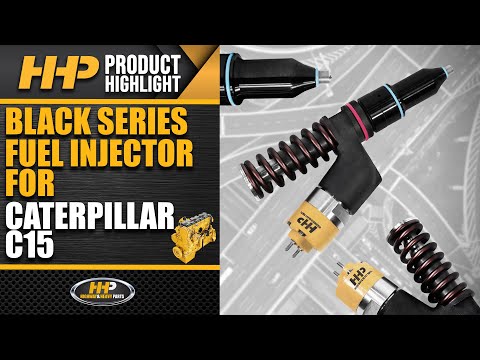
FAQs for Caterpillar C15 Black Series Flow Matched Fuel Injectors
1. What are the signs that my Caterpillar C15 fuel injectors need to be replaced?
If your engine is missing at idle, emitting raw fuel smells from the stacks, or experiencing poor fuel economy, these are strong indicators that your fuel injectors may be failing and need replacement.
2. What makes the Black Series fuel injectors different from standard options?
Black Series injectors are precision-built and flow-matched using advanced fuel injection equipment. They’re calibrated to tolerances within a millionth of an inch for superior pressure containment and performance — delivering optimal timing, efficiency, and power.
3. Why is flow-matching important for fuel injectors?
Flow-matching ensures each injector delivers the same amount of fuel, which promotes balanced combustion across all cylinders. This reduces engine stress, increases efficiency, and improves overall engine performance.
4. Will these injectors improve performance and fuel economy?
Yes. By delivering fuel at precisely the right time and in the right amount, Black Series injectors enhance throttle response, smooth out RPMs, and improve power and fuel efficiency.
5. What warranty is offered with the C15 Black Series fuel injectors?
All Black Series injectors are backed by a 1-year warranty, giving you peace of mind and industry-leading support from ASE-certified technicians.


