You finish a Perkins engine rebuild, go to rotate the crankshaft. And it won’t move.
Or worse, it turns slightly and then binds.
This is one of the most frustrating problems after a rebuild, and it almost always comes down to clearance, alignment, or assembly issues.
If a crankshaft won’t turn freely after assembly, something is wrong. There is no “break-in” that will fix it.
Quick Answer: Why the Crankshaft Won’t Turn
- Incorrect bearing clearances
- Improper crankshaft machining
- Main cap or rod cap misalignment
- Thrust bearing installation issues
- Debris or contamination during assembly
- Incorrect torque sequence or values
Every one of these directly affects how the crankshaft rotates inside the block.
What “Normal” Should Feel Like
Quick takeaway: A properly assembled crankshaft should rotate smoothly with consistent resistance.
With:
- Bearings installed
- Caps torqued to spec
- No pistons installed
You should be able to rotate the crankshaft by hand using a breaker bar. If you feel:
- Tight spots
- Binding
- Uneven resistance
That indicates a mechanical issue: not normal assembly friction.
1. Incorrect Bearing Clearance (Most Common Cause)
Quick takeaway: Too little clearance will lock the crankshaft.
Diesel engines like Perkins rely on precise oil clearance between:
- Crankshaft journals
- Main and rod bearings
Typical oil clearance ranges for many Perkins engines:
- ~0.0015″ to 0.0030″
If clearance is too tight:
- Oil film cannot form
- Metal-to-metal contact increases
- Crankshaft binds or locks
This often happens when:
- Bearings are mismatched
- Journals are machined incorrectly
- Clearances are not verified with plastigage or micrometers
2. Improper Crankshaft Machining
Crankshaft machining must be exact.
Common issues include:
- Incorrect journal sizing
- Out-of-round journals
- Improper surface finish
- Incorrect fillet radius after grinding
The fillet radius (the transition between journal and crank web) is critical.
If it is not properly finished:
- Stress concentration increases
- Bearing fit can be affected
- Rotation can become restricted
In heavy-duty diesel applications, crankshafts are often:
- Precision-ground
- Sometimes shot-peened for durability
Crankshaft condition is just as important as machining accuracy. Learn more about what causes crankshaft damage in our guide on the four main causes of a bent diesel crankshaft: Bent Diesel Crankshaft Guide
3. Main Bearing Cap Misalignment
Quick takeaway: Main caps must be installed in the correct position and orientation.
Each main cap is:
- Line-bored with the block
- Matched to a specific position
If caps are:
- Installed in the wrong location
- Installed backwards
- Torqued unevenly
This can:
- Distort the crank bore
- Pinch the crankshaft
- Cause binding
Even slight misalignment can prevent rotation.
4. Thrust Bearing Installation Issues
The thrust bearing controls:
- Crankshaft end play (forward/backward movement)
If installed incorrectly:
- The crankshaft can bind when torqued
Common mistakes:
- Thrust bearing installed backwards
- Improper seating
- End play not checked
Typical end play must be within spec—too tight and the crankshaft will not rotate freely.
5. Debris or Contamination During Assembly
Quick takeaway: Even small debris can lock a crankshaft.
After machining:
- Metal shavings can remain in oil passages
- Dirt or lint can contaminate surfaces
If debris gets between:
- Bearing and journal
- Bearing and cap
It can:
- Reduce clearance
- Create high spots
- Cause immediate binding
This is why thorough cleaning after machining is critical.
6. Incorrect Torque Sequence or Values
Main caps and rod caps must be:
- Torqued in sequence
- Torqued to specification
If not:
- The crankshaft bore can distort
- Bearings can be unevenly loaded
This creates:
- Tight spots during rotation
- Inconsistent resistance
7. Rear Main Seal and Housing Issues (Perkins-Specific)
Some Perkins engines, such as the 4.108, use:
- Rope-style rear main seals
- Two-piece seal housings
If installed incorrectly:
- The seal can drag on the crankshaft
- Housing misalignment can create resistance
Common issues:
- Seal trimmed incorrectly
- Seal packed too tightly
- Housing sealed improperly
This can make the crankshaft feel tight even if bearings are correct.
8. Connecting Rod Installation Problems
Once pistons and rods are installed, additional issues can appear:
- Rod caps installed incorrectly
- Bearing shells misaligned
- Rods not properly sized
This can:
- Add resistance
- Cause binding at specific rotation points
How to Diagnose a Crankshaft That Won’t Turn
Quick takeaway: Isolate the problem step-by-step.
1. Remove Pistons and Rods
- Check crank rotation with only main bearings installed
2. Check Each Main Cap Individually
- Torque one cap at a time
- Rotate crank after each step
3. Measure Bearing Clearance
- Use plastigage or micrometers
- Verify against spec
4. Check Crankshaft End Play
- Verify thrust bearing installation
- Measure with dial indicator
5. Inspect for Debris
- Clean all surfaces thoroughly
- Check oil passages
This Is a Precision Problem
We see this often:
The parts are new, but the system isn’t correct.
A crankshaft that won’t turn is not a defective part issue.
It’s almost always:
- Machining
- Measurement
- Or assembly accuracy
Diesel engines require tight tolerances. Small errors create big problems.
Final Thoughts
If your Perkins engine crankshaft won’t turn after a rebuild, stop immediately.
Do not force it.
Binding is a sign that:
- Clearances are incorrect
- Components are misaligned
- Or something was assembled improperly
Fixing the issue now prevents:
- Bearing failure
- Crankshaft damage
- Complete engine failure
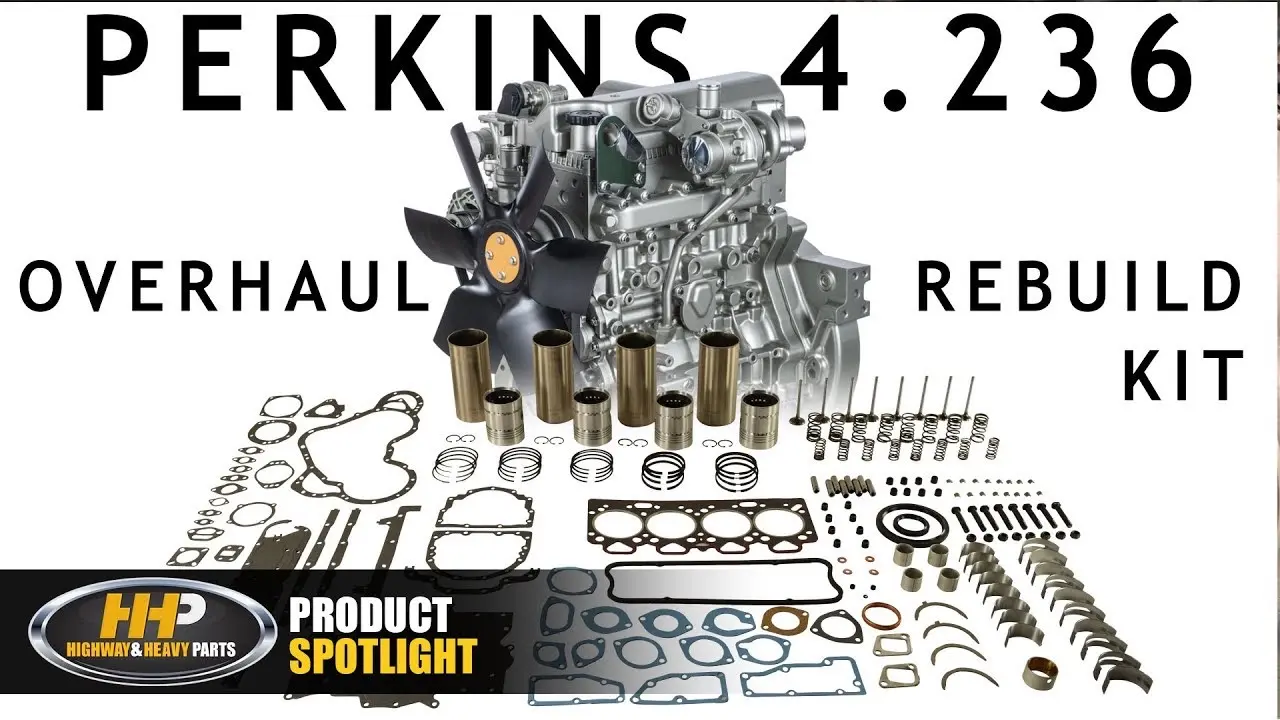
Browse our Perkins engine rebuild kits HERE
Or call 844-304-7688 to speak with a diesel expert.
From diagnosis through delivery, we’re Highway and Heavy Parts.