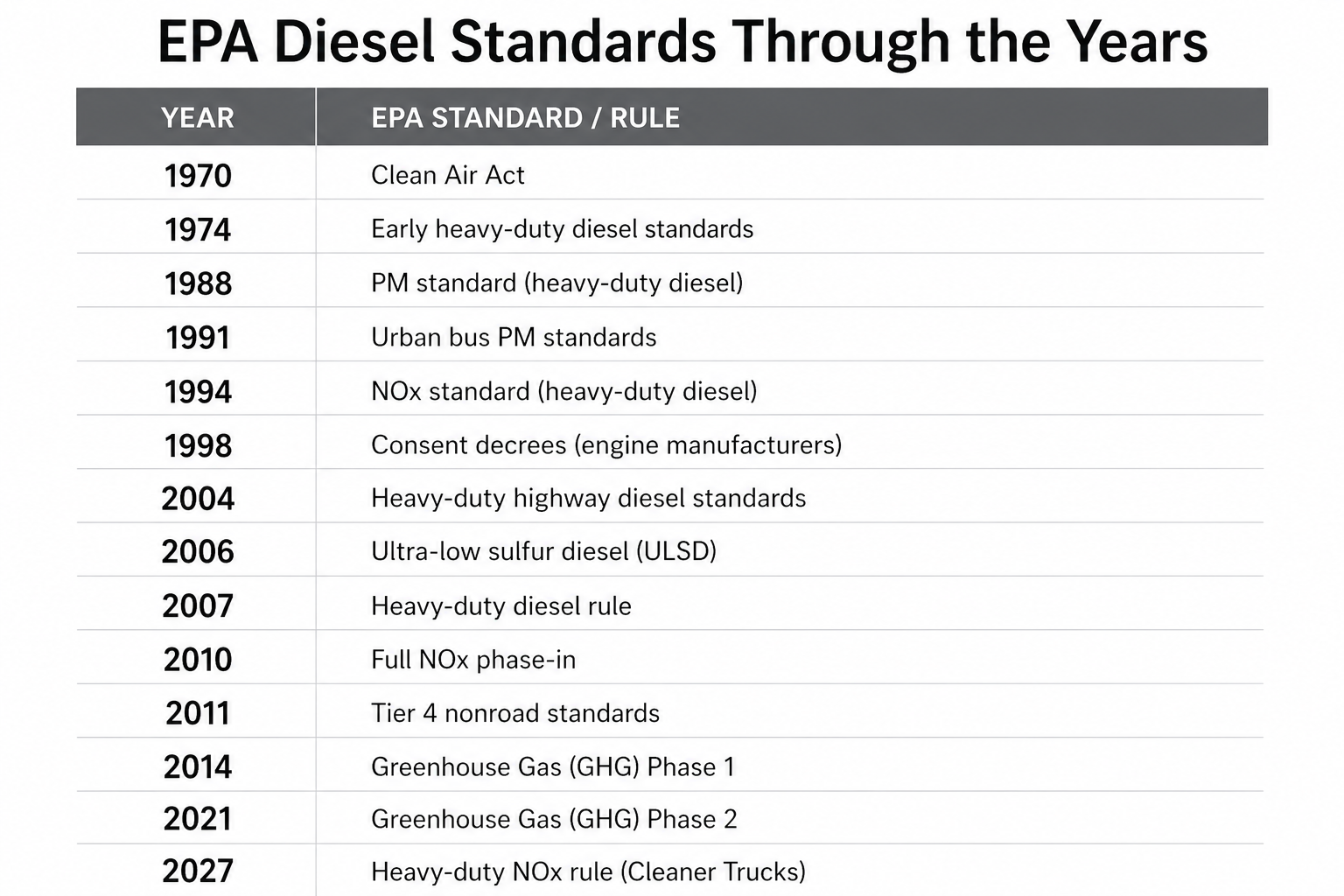
Starting with model year 2027, the U.S. Environmental Protection Agency is implementing updated emissions standards for heavy-duty diesel engines as part of its Clean Trucks Plan.
These regulations focus on one primary goal:
👉 Reducing emissions while ensuring systems remain effective over a longer portion of the engine’s life.
For fleets, owner-operators, and anyone working with diesel engines, the changes are significant, but they are also structured around measurable standards.
This guide breaks down what is changing and how it applies to diesel engines in real-world operation.
Why New Diesel Emissions Standards Are Being Introduced
Heavy-duty diesel engines are a major contributor to nitrogen oxide (NOx) emissions, which are linked to air quality concerns in urban and high-traffic areas.
The 2027 regulations are designed to:
- Reduce NOx emissions
- Improve emissions performance during real-world driving conditions
- Ensure emissions systems remain effective over time
These updates build on previous standards but introduce stricter limits and longer durability requirements.
Drastic Reduction in NOx Emissions
One of the most significant updates is the new NOx limit:
👉 0.035 grams per horsepower-hour (g/hp-hr)
This represents an approximately 80%–90% reduction compared to current standards.
This change applies to heavy-duty engines used in:
- On-highway trucks
- Vocational vehicles
- Other diesel-powered transport applications
The goal is to reduce emissions not just during testing—but across the full operating life of the engine.
New Focus on Low-Load and Real-World Operation
Previous emissions standards focused heavily on highway driving conditions.
The 2027 regulations expand this by targeting:
- Idle conditions
- Stop-and-go driving
- Low-load operation
These conditions are common in:
- Urban delivery routes
- Construction and vocational trucks
- Regional hauling
Engines will be required to maintain cleaner emissions performance even when they are not operating under steady highway load.
Longer Useful Life and Warranty Requirements
Another key change is how long emissions systems are expected to perform.
The EPA is extending the required useful life period, meaning:
- Engines must meet emissions standards for a longer portion of their lifespan
- Manufacturers must support longer warranty periods for emissions components
These updated requirements are typically 1.5 to 2.5 times longer than previous standards.
This shifts the focus from short-term compliance to long-term durability.
More Advanced Aftertreatment Systems
To meet stricter emissions limits, engines will rely more heavily on aftertreatment systems.
These systems may include:
- Selective Catalytic Reduction (SCR) systems
- Dual-stage or dual-chamber SCR designs
- Improved Diesel Particulate Filter (DPF) performance
- Electrically heated catalysts (often using 48-volt systems)
These technologies are designed to:
- Improve emissions control during cold starts
- Maintain performance at low exhaust temperatures
- Reduce emissions across all operating conditions
Updated DEF Inducement Strategy
The 2027 regulations also update how engines respond to Diesel Exhaust Fluid (DEF) issues.
Previously, low DEF levels or system faults could trigger immediate power reduction (commonly referred to as “limp mode”).
Under the new rules:
- Inducement strategies are more gradual and distance-based
- Drivers are given more time to address DEF-related issues before severe power restrictions occur
This change is intended to maintain compliance while reducing sudden disruptions during operation.
What This Means for Diesel Trucks
From a design and operation standpoint, these changes will likely result in:
- More complex emissions systems
- Larger or additional aftertreatment components
- Higher manufacturing and vehicle costs
- Increased focus on system durability and diagnostics
At the same time, engines will be designed to:
- Maintain emissions performance longer
- Operate cleaner under a wider range of conditions
- Meet stricter regulatory requirements over time
What Is Not Changing
It’s important to note that the core function of diesel engines remains the same:
- Combustion process
- Fuel systems
- Turbocharging and airflow systems
The primary changes are focused on emissions control and system longevity, not the fundamental operation of the engine itself.
Final Takeaway
The 2027 EPA diesel regulations introduce:
- Significantly lower NOx limits
- Expanded testing under real-world conditions
- Longer durability and warranty requirements
- More advanced aftertreatment systems
These updates are designed to ensure that emissions reductions are maintained throughout the life of the engine – not just when it’s new.
For fleets and operators, the impact will be seen in:
- Engine design
- Maintenance considerations
- System complexity
Understanding these changes now helps prepare for how diesel engines will be built and maintained moving forward.
Need Help Understanding Diesel Engine Systems?
As emissions systems continue to evolve, diagnosing and maintaining diesel engines becomes more system-focused.
If you’re working through:
- Emissions-related issues
- Performance concerns
- Engine diagnostics
Shop our website or call 844-304-7688 to speak with a diesel expert.
From diagnosis through delivery, we’re Highway and Heavy Parts.


