Diesel has dominated heavy-duty trucking for a reason.
It is energy-dense, widely available, familiar to fleets, and supported by a massive fueling and service network. But it is not the only option.
Natural gas semi trucks have been used in commercial fleets for years, especially in refuse, regional haul, port drayage, delivery, and return-to-base operations. They run on either compressed natural gas (CNG), liquefied natural gas (LNG), or renewable natural gas (RNG), offering a lower-emissions alternative to diesel for certain heavy-duty applications.
They are not perfect. They are not a drop-in answer for every fleet. But they are also not experimental.
Natural gas trucks are one of the more mature alternative-fuel options available for heavy-duty commercial transportation today.
HHP Quick Takeaway
Natural gas semi trucks can reduce emissions and fuel-cost volatility in the right application, especially for fleets with predictable routes and access to CNG, LNG, or RNG fueling. The biggest limitations are fueling infrastructure, onboard fuel storage, upfront cost, range planning, and application fit.
Truck shows are more than just polished builds and chrome.
For diesel repair shops, owner-operators, fleets, and vendors, the right event is an opportunity to:
See new parts and equipment
Connect with suppliers and manufacturers
Learn what’s trending in the industry
Get a closer look at real working trucks and show builds
If you’re planning your 2026 calendar, here are some of the most relevant diesel and semi-truck-focused shows across the United States, organized by month.
👉 Always confirm dates and registration details on official event websites before traveling – many events fill quickly or update schedules.
It requires constant awareness, planning, and decision-making: both on the road and when you’re stopped.
For new and experienced drivers alike, the difference between a smooth operation and a stressful one often comes down to small habits and decisions made throughout the day.
Below are practical, real-world truck driver tips that help keep you safe, efficient, and consistent over time.
Semi-trucks are not all built the same – but most follow a standard size range designed to meet federal regulations and operate efficiently on U.S. highways.
Understanding these dimensions is important for:
Route planning
Bridge clearance
Load compliance
Safety and maneuverability
This guide breaks down standard semi-truck dimensions and explains how those measurements are built.
Standard Semi-Truck Dimensions
A typical tractor-trailer combination in the United States falls within a consistent range:
Measurement
Standard Range
Overall Length
70–80 feet
Trailer Length
48–53 feet
Width
8 feet 6 inches (102 inches)
Height
About 13 feet 6 inches
Gross Vehicle Weight
Up to 80,000 pounds
These are baseline measurements used across most highway applications. Exact dimensions may vary depending on equipment and state regulations.
How Tractor and Trailer Length Work Together
The total length of a semi-truck is not simply the tractor length plus the trailer length.
That’s because part of the trailer sits over the tractor at the fifth wheel.
A typical setup includes:
Tractor: about 20 feet
Trailer: up to 53 feet
Overlap between tractor and trailer
This overlap is what keeps the overall length closer to 70–80 feet instead of exceeding it.
The type of tractor also plays a role. Day cabs and sleeper cabs can vary slightly in wheelbase and overall length, depending on configuration.
Trailer Types and Configurations
Different trailers are designed for different types of freight. While many fall within standard dimensions, their structure and use vary.
Dry Van and Reefer Trailers
These are the most common trailers on the road. They are used for general freight and temperature-controlled goods.
Flatbed Trailers
Flatbeds are used for oversized or irregular loads that cannot be enclosed. Cargo height determines total vehicle height.
Tanker Trailers
Tankers are designed to carry liquids. Their size varies based on capacity and weight distribution requirements.
Step Deck and Double Drop Trailers
These trailers sit lower to the ground, allowing taller freight to stay within legal height limits.
Pup Trailers and Doubles
Shorter trailers, often around 28 feet, are sometimes pulled in pairs depending on the route and regulations.
👉 The key difference between these trailers is not just size—but how they handle weight, height, and cargo.
Height and Clearance Considerations
Most semi-trucks are designed to stay within a standard height of about 13 feet 6 inches.
This height exists for a reason:
Bridge clearances
Overpasses
Tunnels
Loading docks
Even though many highways are designed with higher clearances, not all routes are.
👉 Drivers must always verify height restrictions before entering a route—especially in older infrastructure or urban areas.
Width and Lane Compatibility
The standard width for a semi-truck is 8 feet 6 inches (102 inches). This aligns with standard U.S. highway lane widths, which are typically around 12 feet.
While the truck body fits within this width, mirrors and safety equipment extend beyond it. That’s why the total mirror-to-mirror width can approach 10 feet.
👉 Any load exceeding standard width is considered oversized and requires permits.
Weight Limits and Load Distribution
The maximum gross vehicle weight for a standard tractor-trailer is generally 80,000 pounds.
This includes:
The truck
The trailer
Fuel
Driver
Cargo
Weight limits are also applied at the axle level:
Single axle: up to 20,000 pounds
Tandem axle: up to 34,000 pounds
These limits are designed to protect:
Roads and bridges
Tires and suspension systems
Braking performance
👉 Proper weight distribution is just as important as total weight.
Why Semi-Truck Dimensions Matter
Truck dimensions are not just about compliance—they directly affect performance and operation.
They influence:
Turning radius
Fuel efficiency
Stability under load
Route accessibility
Safety in tight spaces
A truck that exceeds legal dimensions may require:
Special permits
Route planning
Escort vehicles
Restricted travel times
State Regulations and Variations
Federal guidelines provide a baseline for commercial vehicle dimensions, but states can adjust rules based on local conditions.
This means:
Length allowances may vary
Height limits can differ
Weight restrictions may change based on road type
👉 For standard highway trucking, most equipment is built to fit within widely accepted limits. However, specialized freight often requires additional planning.
Final Takeaway
A standard semi-truck in the United States follows a consistent set of dimensions built around safety, infrastructure, and performance.
While most trucks fall within the same general size range, variations in tractor type, trailer configuration, and cargo can change how those dimensions apply in real-world use.
Understanding these measurements helps drivers, fleets, and operators make better decisions when it comes to routing, loading, and compliance.
Call 844-304-7688 or visit highwayandheavyparts.com to get the right diesel engine parts for your application.
From diagnosis through delivery, we’re Highway and Heavy Parts.
You’ve probably heard the phrase – America runs on diesel.
And it’s true.
Diesel engines power the trucks that move freight across the country, the equipment that builds infrastructure, and the machines that keep industries operating every day.
But here’s the part that doesn’t get talked about enough:
👉 What happens when those diesel engines don’t perform the way they should?
Because when a diesel engine goes down, it’s not just one machine: it can slow down an entire operation.
If you operate trucks, equipment, or a diesel shop, you don’t need anyone to tell you that parts, labor, and fuel are some of your biggest expenses. With fuel, a few cents up or down on a gallon of diesel can make or break margins on a lane, a job, or even a whole month.
In this post, we’ll walk through how diesel prices have moved over the last 25 years, then zoom in on what’s happening with diesel fuel right now in 2025 – prices, fuel quality, and what could be coming next.
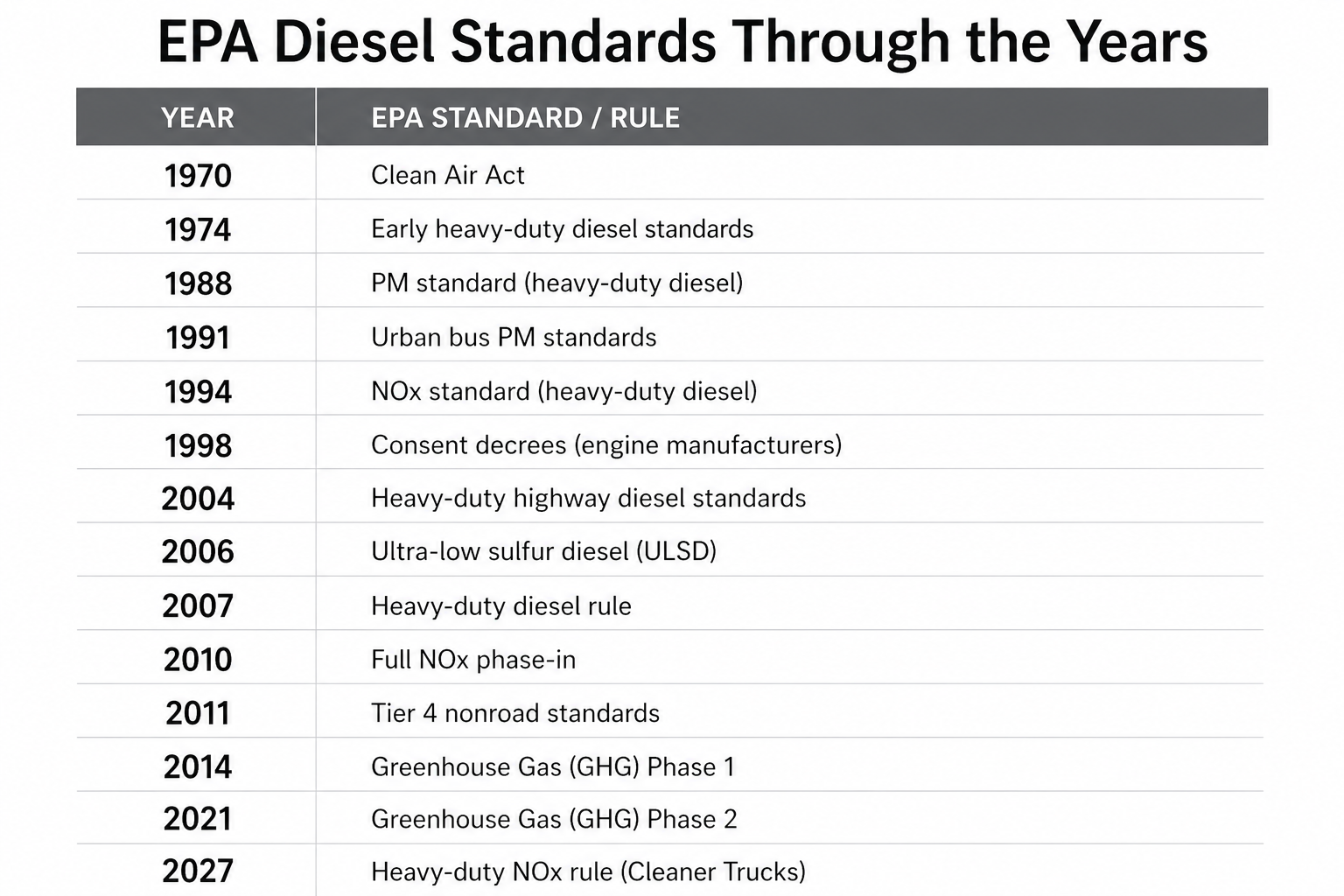
Starting with model year 2027, the U.S. Environmental Protection Agency is implementing updated emissions standards for heavy-duty diesel engines as part of its Clean Trucks Plan.
These regulations focus on one primary goal:
👉 Reducing emissions while ensuring systems remain effective over a longer portion of the engine’s life.
For fleets, owner-operators, and anyone working with diesel engines, the changes are significant, but they are also structured around measurable standards.
This guide breaks down what is changing and how it applies to diesel engines in real-world operation.
Why New Diesel Emissions Standards Are Being Introduced
Heavy-duty diesel engines are a major contributor to nitrogen oxide (NOx) emissions, which are linked to air quality concerns in urban and high-traffic areas.
The 2027 regulations are designed to:
Reduce NOx emissions
Improve emissions performance during real-world driving conditions
Ensure emissions systems remain effective over time
These updates build on previous standards but introduce stricter limits and longer durability requirements.
Drastic Reduction in NOx Emissions
One of the most significant updates is the new NOx limit:
👉 0.035 grams per horsepower-hour (g/hp-hr)
This represents an approximately 80%–90% reduction compared to current standards.
This change applies to heavy-duty engines used in:
On-highway trucks
Vocational vehicles
Other diesel-powered transport applications
The goal is to reduce emissions not just during testing—but across the full operating life of the engine.
New Focus on Low-Load and Real-World Operation
Previous emissions standards focused heavily on highway driving conditions.
The 2027 regulations expand this by targeting:
Idle conditions
Stop-and-go driving
Low-load operation
These conditions are common in:
Urban delivery routes
Construction and vocational trucks
Regional hauling
Engines will be required to maintain cleaner emissions performance even when they are not operating under steady highway load.
Longer Useful Life and Warranty Requirements
Another key change is how long emissions systems are expected to perform.
The EPA is extending the required useful life period, meaning:
Engines must meet emissions standards for a longer portion of their lifespan
Manufacturers must support longer warranty periods for emissions components
These updated requirements are typically 1.5 to 2.5 times longer than previous standards.
This shifts the focus from short-term compliance to long-term durability.
More Advanced Aftertreatment Systems
To meet stricter emissions limits, engines will rely more heavily on aftertreatment systems.
Today, diesel engines power everything from long-haul trucks and construction equipment to locomotives, generators, agricultural machinery, and ocean-going ships.
But when German engineer Rudolf Diesel began working on his revolutionary engine in the 1890s, none of that existed.
In fact, Diesel wasn’t trying to build a better truck engine.
He was trying to solve a much larger problem: How do you create an engine that wastes less energy?
The answer would eventually become one of the most important mechanical inventions in modern history.
Most diesel engine owners want to do everything possible to protect a newly rebuilt engine.
That often leads to a common practice after startup: Letting the engine idle.
At first glance, it seems like the safe thing to do. The engine is running, oil pressure is present, temperatures are stable, and everything appears normal.
The problem is that proper engine break-in requires more than simply running the engine.
According to the testing featured in Black Series Lab Episode 2, extended idle time during break-in may actually work against one of the most important processes occurring inside a freshly rebuilt engine: piston ring seating.